


DNA microarray technology is a game-changer in genomics research. It lets scientists study thousands of genes at once. This gives them deep insights into genetics.
These microarrays are tiny, fitting on a slide the size of a stamp. They need very little DNA or RNA but are super accurate. This is thanks to their ability to test many targets at once.
The tech works by matching DNA or RNA to its match on the chip. This is how it does its job in many fields.
From basic research to helping doctors, these genetic analysis tools have changed how we see genomes and what genes do. They are fast, affordable, and precise. This makes them key in today’s genomics world.
What Is DNA Chip Technology: Core Concepts
DNA chip technology is a game-changer in genetic analysis. It lets scientists study thousands of genes at once. This has changed how we understand genes and their interactions.
Defining DNA Microarray Systems
A DNA microarray, also known as a DNA chip or biochip, has tiny DNA spots on a solid surface. These spots have specific DNA sequences that help in genetic analysis.
These probes interact with sample DNA. This interaction gives us important info on gene expression and genetic variations. The tech’s strength is in handling huge amounts of genetic data at once.
Today’s DNA microarray systems have millions of probes. This density makes them super efficient for detailed genetic studies. Researchers use these chips to measure gene expression across entire genomes.
Related Posts:






The chips are made of:
- A solid surface, like glass or silicon
- Microscopic DNA probes in precise patterns
- Special coatings for DNA attachment
- Optical systems for reading results
The Historical Development of Genetic Chips
The journey of DNA microarray technology started in the late 1980s. Early systems were simple and had limited use. They were mainly used in molecular genetics labs for research.
Patrick O. Brown and his team made big strides in the 1990s. They helped standardise making these chips and made them more reliable. This shift made them more useful for genetic analysis.
Important moments in biochip history include:
- The first commercial microarray systems in the mid-1990s
- Automated making techniques
- Standardised data analysis
- Integration with computer software for results
The tech has grown from analysing hundreds to millions of genetic elements. This has opened new doors in genetic research and medical diagnostics. Today, systems are more precise and reliable than ever.
| Time Period | Development Stage | Key Advancements | Impact on Research |
|---|---|---|---|
| 1980s-1990s | Early Development | Basic probe attachment methods | Limited gene analysis capability |
| 1990s-2000s | Commercialisation | Automated manufacturing | Increased adoption in laboratories |
| 2000s-Present | Modern Refinement | High-density arrays | Comprehensive genomic studies |
Today’s DNA microarray systems are the result of decades of progress. Each step has made them more accurate, capable, and accessible. The tech keeps getting better, giving us deeper insights into genetics.
How DNA Microarray Technology Operates
DNA microarray technology is a powerful tool for genetic insights. It uses advanced biochemistry and engineering to study thousands of genes at once.
The Principles of Nucleic Acid Hybridisation
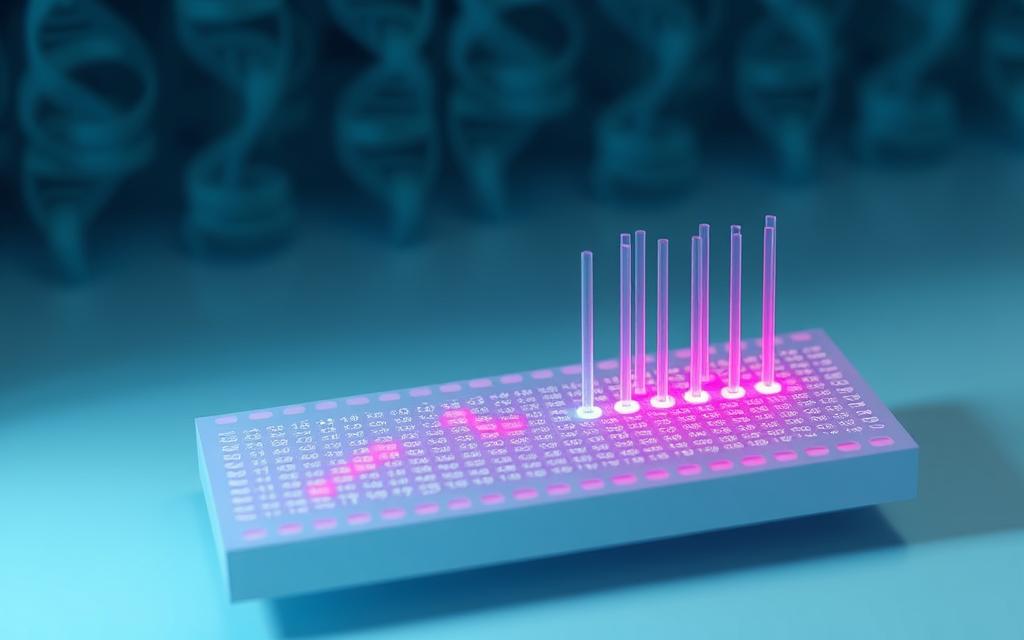
Nucleic acid hybridisation is at the heart of microarray technology. It’s a biochemical process where DNA or RNA strands bind to each other. This happens through hydrogen bonds between matching base pairs.
The hybridisation principle helps measure gene expression. It does this by seeing how sample DNA binds to probes on the chip. This specific binding is key for all analysis in microarray experiments.
Fabrication Techniques for DNA Chips
Creating DNA chips involves advanced techniques. Each method has its own benefits for different research needs.
Spotted arrays use pre-made probes on glass slides. This method is customisable but not as dense as others.
In situ synthesised oligonucleotide arrays are the latest in chip making. Companies like Affymetrix and NimbleGen use cutting-edge methods to create these arrays.
Other methods include:
- Ink-jet printing for flexible probe placement
- Electrochemistry on microelectrode arrays
- Light-directed chemical synthesis
Detection and Data Analysis Methods
After the chips are made, the detection phase starts. Fluorescence detection is the most common. It uses labelled targets that light up when scanned.
Other methods include silver-enhanced labelling and chemiluminescence. Each needs special equipment and data handling.
The scanned images then go through detailed analysis. This includes:
- Converting spots into numbers
- Removing background noise
- Adjusting for experimental variations
- Finding significant changes
Special software is used to understand the huge datasets. This can show patterns in gene expression that older methods can’t.
The whole system of making, hybridising, and detecting is key for genetic analysis. This makes microarray technology essential for today’s genetic research.
Types of DNA Microarrays and Their Specific Applications
Scientists have many microarray platforms to choose from. Each one is best for different research needs. They range from studying many genes at once to finding specific mutations.
cDNA Microarrays: Traditional Methodology
cDNA microarrays were the first in genetic chip technology. They are made by placing PCR-amplified cDNA fragments on glass slides. This is done with precise robots.
This old method is good for studying gene expression when cost is a concern. The cDNA fragments are 200 to 500 base pairs long. This size helps them stick well to the slides.
Even though newer methods exist, cDNA microarray is useful in schools and for initial tests. It’s easy to make and needs only basic lab tools.
Oligonucleotide Arrays: High-Density Precision
Oligonucleotide arrays use short, made DNA sequences instead of cDNA. They are better at finding small genetic differences.
They can spot tiny changes like different splicing and single-base differences. These arrays are made using special printing or photolithography.
Each oligonucleotide array has millions of probes. This lets researchers study the whole genome in detail. They are perfect for detailed genetic studies.
SNP Arrays for Genetic Variation Analysis
SNP arrays focus on finding single nucleotide changes across the genome. They have probes for specific nucleotide changes at known spots.
They are key in genome-wide association studies (GWAS) for complex diseases. SNP genotyping helps find genetic markers for diseases like heart issues and cancers.
These arrays also help in studying how genes affect drug responses. Modern SNP arrays can find rare but important genetic variations.
| Microarray Type | Probe Characteristics | Key Advantages | Primary Applications |
|---|---|---|---|
| cDNA Microarray | Spotted PCR products (200-500bp) | Cost-effective, accessible fabrication | Gene expression profiling, educational use |
| Oligonucleotide Array | Short synthesised sequences (25-70bp) | High density, excellent specificity | Whole-genome analysis, splice variant detection |
| SNP Array | Allele-specific probes | High-throughput genotyping | GWAS studies, pharmacogenomics, disease association |
Choosing a platform depends on what you want to study, your budget, and how detailed you need to be. Each type is getting better with new technology, making them more useful for research.
Practical Applications in Genetic Analysis
DNA microarray technology has changed genetic research a lot. It gives scientists tools to study many genes at once. This helps us understand how life works and how diseases start.
Gene Expression Profiling in Research
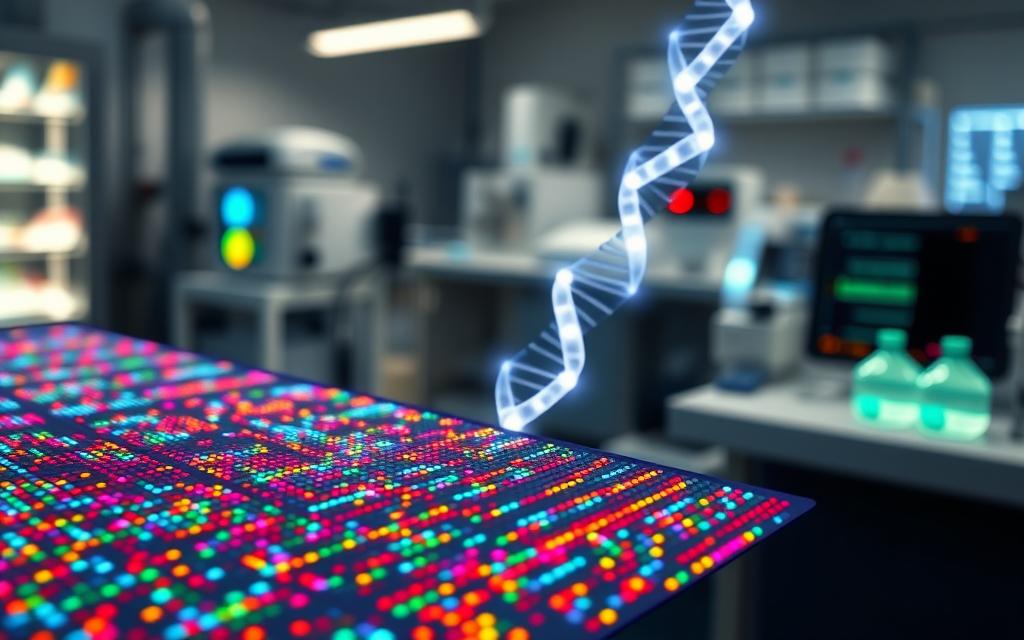
Scientists use DNA microarrays for gene expression profiling. They look at how genes work in the whole genome. This shows which genes are on or off, giving insights into how cells work.
Research uses DNA microarrays for many things:
- They find genes linked to diseases
- They see how cells react to changes
- They study how different tissues develop
- They compare healthy and sick states
Population studies are also important. They help find out who might get diseases like breast cancer. This helps in planning prevention and treatment.
Clinical Diagnostics and Medical Applications
DNA microarray technology has moved into clinical diagnostics. It helps doctors find and manage diseases. It can spot genetic markers and pathogens very accurately.
Medical uses today include:
- Testing for hereditary cancer syndromes
- Finding pathogens in diseases
- Finding chromosomal problems
- Planning treatments based on genes
Medical labs use microarrays for tests. They find genetic changes linked to diseases. This makes diagnosis better and helps treat diseases sooner.
Pharmacogenomics and Therapeutic Development
Pharmacogenomics has grown a lot with microarray technology. It helps understand how genes affect how we react to drugs. This leads to treatments made just for you.
Key uses in making drugs include:
- Finding genetic markers for drug success
- Spotting risks of bad reactions
- Creating drugs for specific genetic profiles
- Adjusting drug doses based on genes
Pharmaceutical companies use microarray data to make better drugs. They make drugs that fit your genetic makeup. This makes treatments safer and more effective.
Microarray technology has changed drug making. It helps make treatments that fit each person’s genes. This is a big change in how we treat diseases.
Advantages and Limitations of Microarray Technology
DNA microarray technology is a powerful tool in genetic analysis. It has both great benefits and some limitations. This helps researchers choose the right tool for their work.
Key Benefits of High-Throughput Genetic Screening
The biggest plus of microarray systems is their ability for high-throughput screening. They can check thousands of genetic elements at once. This speeds up research a lot.
Other benefits include:
- Cost-effectiveness: Microarrays are cheaper than big sequencing projects for focused genetic studies
- Sample conservation: They use little biological material for detailed genomic studies
- Statistical robustness: They use many spots to make measurements more accurate and reliable
These points make microarrays great for big studies and screenings. They are good when money and sample size are limited.
Technical Challenges and Current Limitations
Even with their strengths, microarrays have some microarray limitations to consider. Early worries about reliability have been fixed with new tech.
Today’s challenges are:
- Data analysis challenges: They need special skills for complex data handling
- Sensitivity constraints: They’re not as good at finding rare genes as RNA-Seq
- Technical artefacts: Issues like cross-hybridisation and background noise can mess up results
These issues mean researchers need to plan carefully. They also need to use other methods to check their findings, for genes that are hard to find or study.
The tech is getting better, with new probe designs and detection methods. This makes it more reliable and useful. But, researchers must think about what they need for their project when choosing tools.
Conclusion
DNA microarray technology has changed how we understand genetics. It gives us deep insights into genes and their activity. This tool creates huge amounts of data, showing us how complex life systems work.
It has moved from being a new idea to a key tool in many areas. Microarrays are now vital in diagnosing diseases and finding new medicines. They are also cost-effective compared to newer methods like next-generation sequencing.
These arrays are getting better, like tiling arrays for studying non-coding RNAs. The future looks good for microarrays, even with new technologies coming up. They are great for big studies and will keep helping in making medicine more personal and preventive.
FAQ
What is DNA chip technology or microarrays?
DNA chip technology, also known as microarrays, is a tool for genetic analysis. It uses a chip with thousands to millions of DNA probes. This lets researchers study many genes at once.
FAQ
What is DNA chip technology or microarrays?
DNA chip technology, also known as microarrays, is a tool for genetic analysis. It uses a chip with thousands to millions of DNA probes. This lets researchers study many genes at once.
How do DNA microarrays work?
FAQ
What is DNA chip technology or microarrays?
DNA chip technology, also known as microarrays, is a tool for genetic analysis. It uses a chip with thousands to millions of DNA probes. This lets researchers study many genes at once.
FAQ
What is DNA chip technology or microarrays?
DNA chip technology, also known as microarrays, is a tool for genetic analysis. It uses a chip with thousands to millions of DNA probes. This lets researchers study many genes at once.
What are the main types of DNA microarrays?
FAQ
What is DNA chip technology or microarrays?
DNA chip technology, also known as microarrays, is a tool for genetic analysis. It uses a chip with thousands to millions of DNA probes. This lets researchers study many genes at once.
FAQ
What is DNA chip technology or microarrays?
DNA chip technology, also known as microarrays, is a tool for genetic analysis. It uses a chip with thousands to millions of DNA probes. This lets researchers study many genes at once.
What are the applications of DNA microarray technology?
FAQ
What is DNA chip technology or microarrays?
DNA chip technology, also known as microarrays, is a tool for genetic analysis. It uses a chip with thousands to millions of DNA probes. This lets researchers study many genes at once.
FAQ
What is DNA chip technology or microarrays?
DNA chip technology, also known as microarrays, is a tool for genetic analysis. It uses a chip with thousands to millions of DNA probes. This lets researchers study many genes at once.
What are the advantages of using DNA microarrays?
FAQ
What is DNA chip technology or microarrays?
DNA chip technology, also known as microarrays, is a tool for genetic analysis. It uses a chip with thousands to millions of DNA probes. This lets researchers study many genes at once.
FAQ
What is DNA chip technology or microarrays?
DNA chip technology, also known as microarrays, is a tool for genetic analysis. It uses a chip with thousands to millions of DNA probes. This lets researchers study many genes at once.
What are the limitations of DNA microarray technology?
FAQ
What is DNA chip technology or microarrays?
DNA chip technology, also known as microarrays, is a tool for genetic analysis. It uses a chip with thousands to millions of DNA probes. This lets researchers study many genes at once.
FAQ
What is DNA chip technology or microarrays?
DNA chip technology, also known as microarrays, is a tool for genetic analysis. It uses a chip with thousands to millions of DNA probes. This lets researchers study many genes at once.
How has DNA microarray technology evolved over time?
FAQ
What is DNA chip technology or microarrays?
DNA chip technology, also known as microarrays, is a tool for genetic analysis. It uses a chip with thousands to millions of DNA probes. This lets researchers study many genes at once.
FAQ
What is DNA chip technology or microarrays?
DNA chip technology, also known as microarrays, is a tool for genetic analysis. It uses a chip with thousands to millions of DNA probes. This lets researchers study many genes at once.
How do fabrication techniques differ among DNA microarrays?
FAQ
What is DNA chip technology or microarrays?
DNA chip technology, also known as microarrays, is a tool for genetic analysis. It uses a chip with thousands to millions of DNA probes. This lets researchers study many genes at once.
FAQ
What is DNA chip technology or microarrays?
DNA chip technology, also known as microarrays, is a tool for genetic analysis. It uses a chip with thousands to millions of DNA probes. This lets researchers study many genes at once.
Can DNA microarrays be used in personalised medicine?
FAQ
What is DNA chip technology or microarrays?
DNA chip technology, also known as microarrays, is a tool for genetic analysis. It uses a chip with thousands to millions of DNA probes. This lets researchers study many genes at once.
How do microarrays compare to next-generation sequencing technologies?
FAQ
What is DNA chip technology or microarrays?
DNA chip technology, also known as microarrays, is a tool for genetic analysis. It uses a chip with thousands to millions of DNA probes. This lets researchers study many genes at once.
FAQ
What is DNA chip technology or microarrays?
DNA chip technology, also known as microarrays, is a tool for genetic analysis. It uses a chip with thousands to millions of DNA probes. This lets researchers study many genes at once.
 Marcin Wieclaw